 CELPIP10
Post 7: CELPIP Listening: where to take few notes and where to take many
Updated 15 Nov 2026
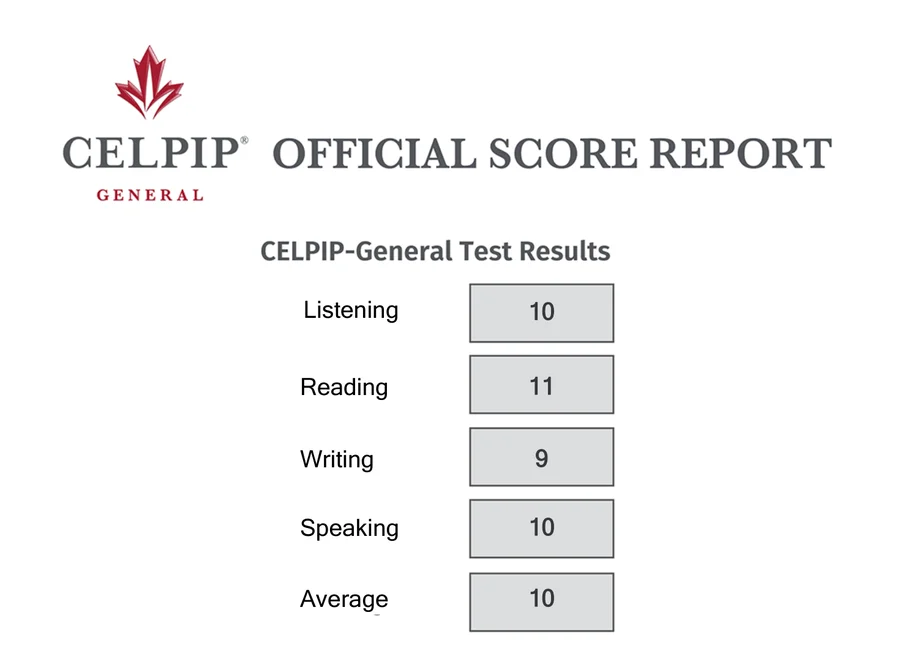
I got a 10 in Listening on the real test. I learned how to handle the Listening section from the CELPIP prep course I took back then, and in short it was: in Parts 1 to 3 you mostly listen, in Parts 4 to 6 you take lots of notes. In this post I go through each part, plus a few traps that come up when you pick an answer.
First, a few things about the format. Listening has 6 parts, each recording plays only once, and you can't see the questions beforehand, they only appear after the recording ends. In the test room you get paper and a pen for notes, and you can raise your hand for more paper. Your notes aren't scored and you hand them in at the end, so write them any way you like as long as you can read them.
Parts 1 to 3: Listen to understand, only write names, numbers and lists
The first three parts are everyday conversations, short enough to remember. If you keep your head down writing, it's easy to miss the next sentence, and these parts often ask how the speaker feels or what they want, so you need to catch the tone of voice too. Imagine you're standing in that conversation and the person is talking to you, and you'll focus better without trying.
Keep your pen ready, though. When you hear a name, a number, a date or time, an address, or a quick list (like a car that has leather seats, a sunroof and heated seats…), write down just that, because those are easy to forget and the questions love to ask about them.
CELPIP's own study materials recommend taking notes in all 6 parts. If you tend to forget things right after hearing them, go ahead and take notes in Parts 1 to 3 too. Try both ways when you practise and keep whichever gives you the higher score.
Parts 4 to 6: Take lots of notes, use symbols
From Part 4 on the recordings get longer, faster and harder, with almost no pauses, so now taking notes matters more than the risk of being distracted. You can't write full sentences in time, so write keywords and use symbols:
- Arrows → for cause and effect; ↑ ↓ for going up and down.
- + when someone agrees, − when they disagree, = when two things are the same.
- Shorten long phrases, for example nonprofit organization becomes NPO, and draw a quick sketch if that's faster than writing.
- Always write down names of people and organizations, numbers and percentages, because there's almost always a question about them.
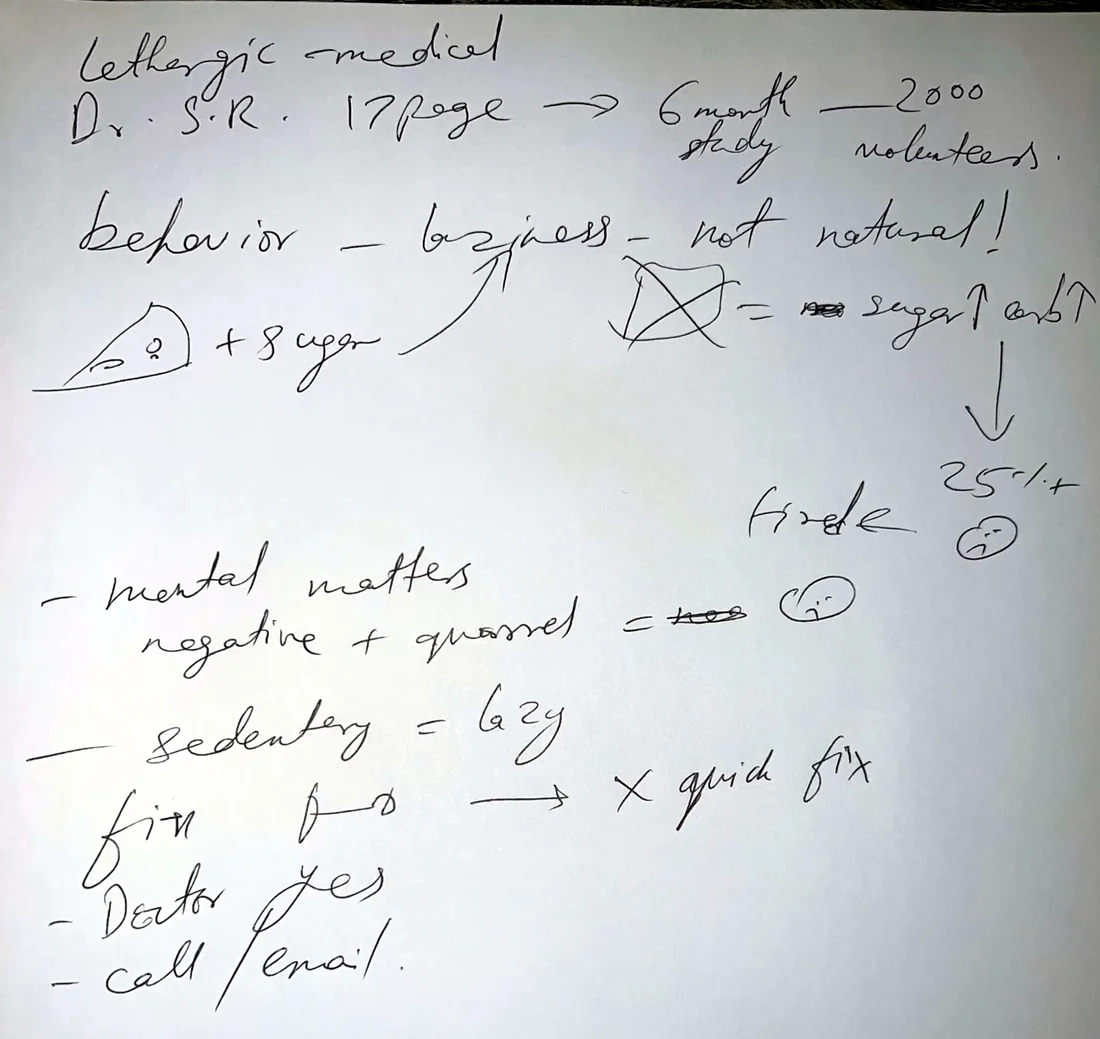
Real Part 4 notes from the teacher of the prep course I took: arrows, ↑, =, drawings instead of words, a sad face for feelings, and every number written down (6-month study, 2,000 volunteers). Messy spelling is fine.
Messy handwriting and bad grammar are fine. If a part goes too fast, write a few main words, leave a gap, keep listening and fill it in later. For anything you decide to keep in your head instead of writing, repeat it to yourself once right then, or it will be gone by the next sentence. Feelings are hard to write down, you have to listen for them, at most draw a smiley or sad face next to that person's name.
Part 5 is a video of three people in a discussion, and the questions often ask who said what. Look at the screen at the start and end of the video so you know who's who, then split your page into three columns like I wrote in Post 1. When you hear someone's name, write it at the top of their column straight away.
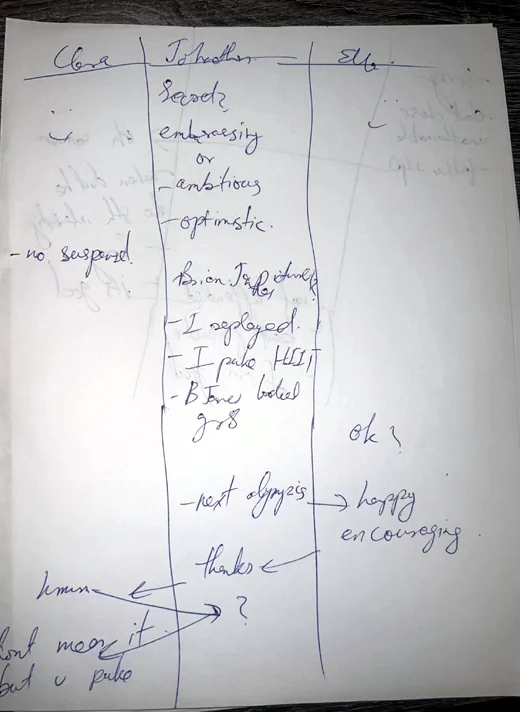
Real Part 5 notes from the teacher of the prep course I took: one column per person, each name written at the top as soon as it's heard, and arrows showing who answers whom.
Part 6 usually has two or three people or organizations with different views. Each time a new speaker starts, open a new column and write who they are, whether they're for or against, and why. Numbers and statistics in this part almost always get a question.
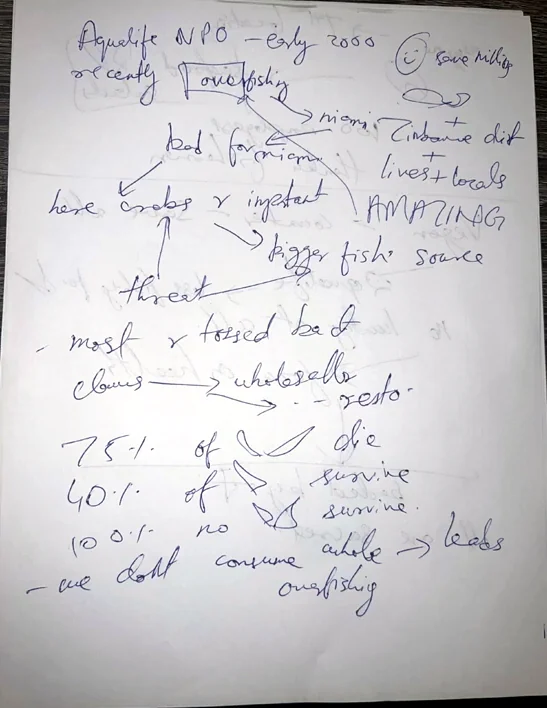
Real Part 6 notes from the teacher of the prep course I took: long phrases shortened (nonprofit organization becomes NPO), arrows linking causes and results, every percentage written down, and a crab claw drawn instead of written.
When you pick an answer
When a question appears, try to answer it in your head first, then read the four options, and read all four, because often two of them sound right but only one is more right. Wrong options often reuse the exact words you just heard and change one detail, for example the talk says 2,000 hours and the wrong option says 2,000 people. So don't pick an option just because the words match, check that the meaning matches. Be suspicious of options with very strong words like "proven", "the first" or "always". If you're stuck between two, choose the one you can prove with your notes. For "which is NOT" questions, the answer is often the one that's different from the other three.
Note paper
You don't get much paper, and in Parts 4 to 6 you'll use it up fast. Raise your hand for more when you see you're running low, don't wait until it's all gone, because it takes a few minutes for someone to bring it.
Listening practice outside of tests
When you practise with tests, take notes on paper with a pen like on test day, not on a keyboard, because handwriting speed is very different. When you finish, open the transcript and compare it with your notes to see what you missed. Outside of tests, pick a talk on YouTube, listen for 1 minute, pause, and say the main ideas out loud, then go up to 2 minutes, 3 minutes, then the whole talk, and finally listen again to see what you forgot. When you watch movies or TV, turn the subtitles off.