 CELPIP
The 8 CELPIP Speaking tasks, with an answer frame for each one
Updated 6 Nov 2026
When I took IELTS, my Speaking stopped at 6.5. On CELPIP I got a 10 in Speaking (score report below). The format of CELPIP Speaking looks harder than IELTS, because the eight tasks are eight different types of speaking, but in my opinion it's graded more easily and it's easier to get a high score. I didn't use any fancy words either. I just practised until each task felt familiar and had an answer frame ready for each one, so when the timer was running I knew what to say next. Here are the frames for all eight tasks, along with CELPIP's own guidance and what people who scored 10 to 12 in Speaking have shared.
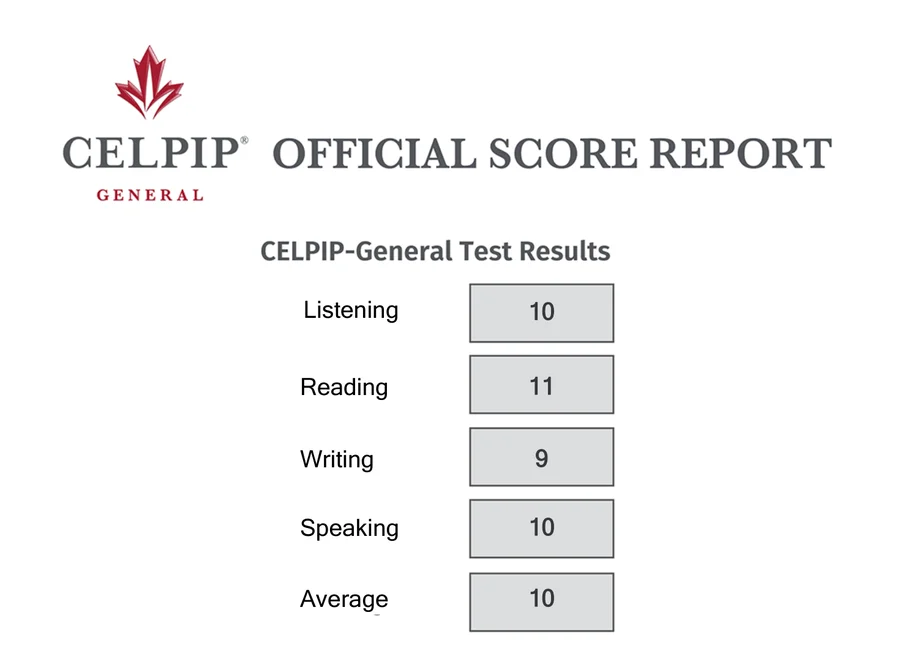
One thing to keep in mind first. Memorize the frame and a few linking phrases, but don't memorize whole answers, because CELPIP warns that responses that aren't original and spontaneous may lead to your score being cancelled. Linking phrases are fine as long as the content is your own details.
Task 1: Giving Advice (30 seconds to prepare, 90 seconds to speak)
You have 90 seconds here, so you need enough ideas. CELPIP suggests giving at least three suggestions, each with a reason or an example. Greet the person and react to their situation, go through your three pieces of advice, then finish with the most important one. Useful phrases are "I'd really recommend…", "Another thing you could do is…" and "One thing I'd avoid, though, is…".
Task 2: Talking about a Personal Experience (30 seconds to prepare, 60 seconds to speak)
The prompt usually ends with a few small questions, such as what happened and how you felt, so make sure you answer all of them. Open with when and where it happened, then give the background, what happened, how you felt and why you still remember it. A story from your own life is easier to tell, but if nothing comes to mind, it's fine to imagine some of it.
Task 3: Describing a Scene (30 seconds to prepare, 60 seconds to speak)
The listener can't see the picture, so start with a general sentence about where this is and what's going on, then follow a fixed order, left to right or top to bottom. In each area, say what people are doing, what they're wearing and whether they look happy or worried. Use plenty of location prepositions and linking words instead of repeating "there is… there is…". There's almost always one strange or hard-to-describe detail in the picture, so remember to mention it. A typical frame goes "This picture shows…", "On the left…", "In the middle…", "Over on the right…", "In the background…", "One thing that really stands out is…".
Task 4: Making Predictions (30 seconds to prepare, 60 seconds to speak)
This task uses the same picture as Task 3, so don't describe it again. Start with one general prediction, then make predictions for two or three groups of people in the picture. Add whether they'll be happy or disappointed about it, and why you think so. You can use "will most likely…", "Chances are…" and "Then again, they might…".
Task 5: Comparing and Persuading (60 seconds to choose, 60 seconds to prepare, 60 seconds to speak)
In the first part you only choose an option, with no speaking. In the second part you have to persuade the other person by comparing, so don't just praise your own choice. Open by acknowledging what's good about their option ("I can see why you like…"), compare two points such as price or time ("…, while…"), bring up their strongest point and explain why it matters less, then wrap up.
Task 6: Dealing with a Difficult Situation (60 seconds to prepare, 60 seconds to speak)
The prompt gives you two ways to handle the situation. Choose one, then talk directly to that person instead of talking about them. You could start with "Hi Tom, do you have a minute?". Then get to the main point, give your reasons, show you understand how they feel, offer a solution and end on a warm note. Tone is part of the score, so stay polite from start to finish.
Task 7: Expressing Opinions (30 seconds to prepare, 90 seconds to speak)
State clearly whether you agree or not in your first sentence. Then give about three reasons, as CELPIP suggests, each with an example, and restate your opinion in different words at the end. This task should sound a little more formal, with linking words like "furthermore" and "nevertheless".
Task 8: Describing an Unusual Situation (30 seconds to prepare, 60 seconds to speak)
You're usually asked to call someone and describe something they can't see, and there's often one more request, such as asking whether you can buy it. Describe its shape, what familiar object it's about the size of, its colour and material, then its strangest detail. Remember to do what the prompt asks at the end.
Preparation time and Speaking
Use the preparation time to understand the prompt, think of ideas and jot down a few words following the frame. While speaking, watch the timer so that you say enough and finish your last sentence before time runs out. Speak at a comfortable pace and a normal volume, and try to limit fillers and self-corrections. Don't worry about your accent as long as the listener can understand you, and idioms aren't required either.
Many people take the CELPIP Speaking test in the same room, so it will be noisy and can be distracting. Prepare yourself for that in advance.
When you first start practising, give yourself more preparation time, then gradually shorten it to the time on the test. It also helps to record yourself and listen back for anything that's hard to understand.