 CELPIP
 Reading: how I read one paragraph at a time and got to 11
Updated 6 Nov 2026
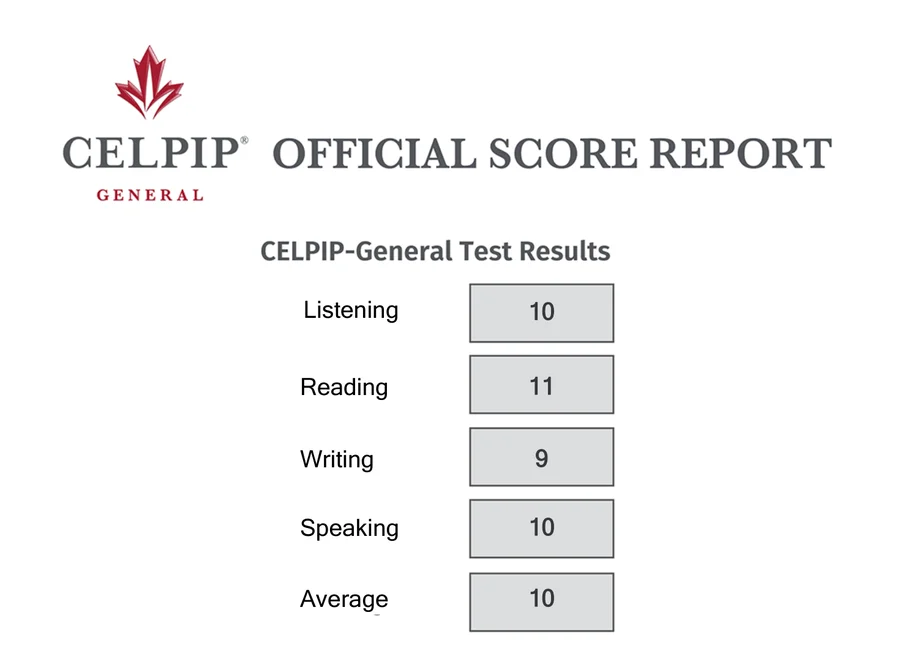
My first CELPIP Reading practice test was CLB 8. After I changed the way I read, I got an 11 in Reading (score report below).
CELPIP Reading is often rated harder than IELTS General. The passages themselves aren't hard to understand, they're everyday things like emails, information sheets and opinion articles. But nearly every question is multiple choice and asks you to infer and really understand, more than normal IELTS Reading does. CELPIP's official guide also says plainly that you should never expect the correct answer to use the exact words from the passage. So scanning for keywords and copying words out, the way you might on IELTS gap-fill questions, doesn't get you very far. You have to understand what the paragraph is saying. I picked up the method below from two IELTS teachers with 8.5 and 9.0 and a teacher with an 800 in SAT Reading, then applied it myself while practising for CELPIP.
Read one paragraph, answer, then read on
Instead of reading a question and then hunting for keywords all over the passage, read from the top, one paragraph at a time. After paragraph 1, look through all the questions and answer any that this paragraph covers. Then read paragraph 2, check the questions again, and keep going to the end. You only have to hold one short paragraph in your head at a time, so it's easier to be sure of your answer, and you don't flip back and forth as much. As you read, ask yourself how this paragraph connects to the one before it: does it add to it, contrast with it or explain the cause? Many questions are about the main idea and what the writer thinks.
One thing you should know is that CELPIP questions don't follow paragraph order. I went back through 28 practice tests, and in Part 3 the answers are completely mixed up: question 1 might be in paragraph B, question 2 in A, question 3 in C, question 4 in D, then question 5 goes back to C. Parts 1 and 4 usually stay close to the order of the passage, but some tests jump around, and some questions are about the whole passage, like what the main purpose of the email is. So after each paragraph, go through the whole list of questions instead of only looking for the next one. Leave the questions about the whole passage until last.
Part 3 (Reading for Information) is one passage split into four paragraphs, A, B, C and D, with 9 statements. For each statement, you choose which paragraph contains that information. If no paragraph has it, choose E, which means the passage doesn't mention it. After paragraph A, go through the 9 statements and pick A for any that match it, then do the same for B, C and D. Once you've finished all four paragraphs, read any statements left over carefully again, and if you still can't find them, choose E. Two things to remember: a paragraph has to contain all of the information in the statement before you choose it, and a statement that's only half right, with the other half missing or wrong, is still E. Part 4 is a passage with several points of view, so as you read, notice who is mentioned, what they think and why.
Timing
Before reading closely, skim the passage for 30–40 seconds to see what it's about. Time is fairly tight: Part 1 has 11 questions in about 11 minutes, Part 2 has 8 questions in 9 minutes, Part 3 has 9 questions in 10 minutes, and Part 4 has 10 questions in 13 minutes. Don't get stuck on one question, and don't leave any blank.
Reading practice outside of tests
Besides doing tests, one method I think is well worth trying is "realistic reading" from Professor Alexander Arguelles, known for having studied about 50 languages. Choose a passage at your level and read it once for the general idea, listening along if it has audio. The second time, read it aloud yourself and mark the words you don't know. Then look up and note only the words that stop you understanding the sentence, usually the main verbs and nouns. Adjectives and adverbs only add detail, so you can skip them. Finally, read the passage once more before moving on to another one. This works best when you already understand about 90–95% of a text (5–10 unknown words in every 100).